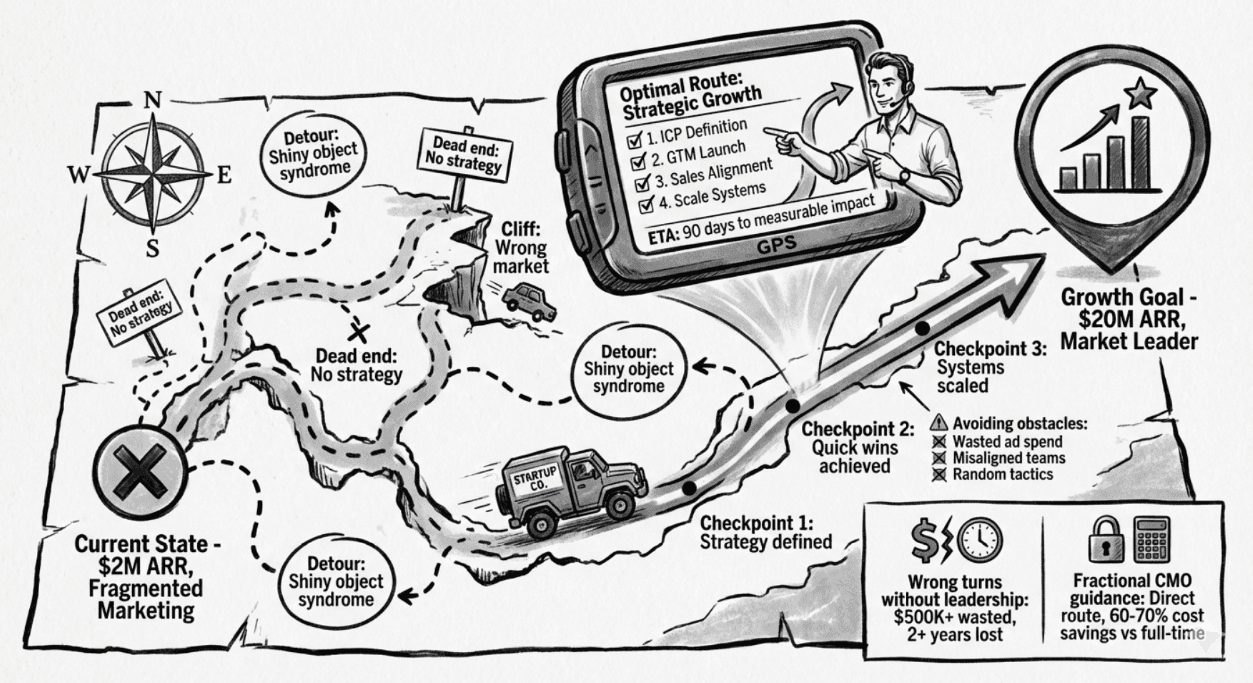
How to Hire a Fractional CMO and Accelerate Scalable Growth in 2026

Written by: Jayant Kshirsagar
As businesses scale, many reach a point where growth slows, marketing efforts feel fragmented, and results become harder to predict. Campaigns may be running, content is being produced, and tools are in place — yet there’s no clear strategic direction tying everything together.
In most cases, the issue isn’t a lack of talent or effort. It’s the absence of experienced marketing leadership that can connect strategy, execution, and revenue outcomes.
This is where more companies are choosing to hire a fractional CMO.
According to industry research, organizations that add senior marketing leadership earlier in their growth journey tend to achieve stronger alignment between brand, demand generation, revenue, and valuations. Fractional CMOs make this possible without the long-term cost or commitment of a full-time executive.
What Is a Fractional CMO?
A fractional CMO is a senior marketing leader who works with a company on a part-time or contract basis. Instead of focusing on day-to-day execution alone, they provide strategic oversight, leadership, and accountability across marketing functions.
Unlike consultants who primarily advise, fractional CMOs often embed themselves within leadership teams. Their role typically includes:
Defining marketing strategy and priorities
Aligning marketing with sales and business goals
Building scalable systems and processes
Measuring performance against clear KPIs
This model is especially attractive to startups and mid-sized companies that need executive-level guidance but aren’t ready for a full-time CMO.
Why Businesses Are Choosing Fractional CMOs Over Full-Time Hires
Hiring a full-time CMO is a major investment. Compensation, benefits, onboarding time, and long-term risk all add up — particularly for growing companies that need flexibility.
Fractional CMOs offer several practical advantages:
1. Cost Efficiency
A full-time CMO can cost well over six figures annually. Fractional engagements typically provide access to the same level of expertise at a significantly lower cost, making senior leadership more accessible.
2. Faster Impact
Fractional CMOs are usually experienced operators. They come in with proven frameworks and can start identifying gaps and opportunities quickly, rather than spending months learning basic context.
3. Flexibility
As business needs change, the level of involvement can scale up or down. This is particularly useful during funding rounds, product launches, or market expansion phases.
The Core Benefits of Hiring a Fractional CMO
A strong fractional CMO focuses on outcomes, not just activity. Their value often shows up in four key areas:
Strategic Clarity
They define what matters most — from positioning and messaging to pipeline contribution — and ensure marketing efforts are tied to business objectives.
Team and Partner Alignment
Fractional CMOs bring structure to internal teams and external agencies, helping everyone operate from a shared strategy rather than working in silos.
Faster Go-to-Market Execution
Whether launching a new product or entering a new market, they help reduce delays between planning and execution.
Scalable Marketing Foundations
From CRM setup to reporting dashboards, fractional CMOs build systems that can grow with the business instead of breaking under pressure.
Fractional CMOs and Global Market Expansion
As companies expand into new regions, marketing complexity increases. Messaging that works in one market may not resonate in another, and channel strategies often need adjustment.
Fractional CMOs with cross-market experience can help organizations balance global consistency with local relevance. This is particularly valuable for B2B and SaaS companies entering regions such as Middle East, Southeast Asia, US or Europe, where buyer behavior and go-to-market dynamics differ.
The Role of Fractional CMOs in Product Marketing
Strong growth depends on how well a product is positioned in the market. Fractional CMOs often play a key role in:
Clarifying product value propositions
Aligning messaging with real customer pain points
Supporting go-to-market planning
Enabling sales teams with clear narratives
When product, marketing, and sales are aligned, companies tend to see more predictable and sustainable growth.
What to Expect From Fractional CMO Services
While engagement models vary, most fractional CMOs focus on ownership and accountability rather than one-off advice. Typical responsibilities may include:
Setting and tracking marketing OKRs
Establishing performance dashboards
Leading cross-functional planning sessions
Providing regular updates to leadership
The goal is to turn marketing into a measurable, repeatable growth function rather than a cost center.
When Does It Make Sense to Hire a Fractional CMO?
Hiring a fractional CMO is often a good fit when:
Marketing efforts lack focus or consistency
Growth has plateaued despite continued investment
A company is preparing for expansion, funding, or a major launch
Leadership needs strategic oversight without adding another full-time executive
Timing matters. Bringing in senior leadership earlier can help prevent costly misalignment later.
How to Hire the Right Fractional CMO
Before hiring, companies should:
Define success metrics and priorities
Start with a discovery conversation to assess alignment
Agree on clear KPIs and expectations
Treat the relationship as a partnership, not a handoff
The most effective fractional CMOs work closely with leadership teams and integrate deeply into the business.
Final Thoughts
Fractional CMOs have become a practical solution for companies navigating complex growth challenges. By combining senior-level strategy with flexibility, they help organizations bring clarity to marketing, align teams, and build scalable growth engines.
Q1. What does it mean to hire a fractional CMO?
Hiring a fractional CMO means bringing in a senior marketing leader on a part-time or contract basis. They provide strategic oversight, align marketing with business goals, and help build scalable systems without the commitment of a full-time executive role.
Q2. How is a fractional CMO different from a full-time CMO?
The primary difference is the engagement model. A fractional CMO offers the same level of strategic leadership as a full-time CMO but works on a flexible basis, making it a cost-effective option for growing companies.
Q3. When should a company consider a fractional CMO?
A company should consider a fractional CMO when marketing efforts feel disconnected, growth slows, or leadership needs experienced guidance during transitions such as expansion, product launches, or fundraising.
Q4. What types of businesses benefit most from fractional CMOs?
Fractional CMOs are commonly hired by startups, SaaS companies, and mid-sized B2B organizations that need strategic marketing leadership but are not ready for a full-time CMO hire.
Q5. How long does a typical fractional CMO engagement last?
Engagements vary by business need. Some companies work with a fractional CMO for a few months to solve specific challenges, while others maintain long-term partnerships as they scale.
Q6. What results can businesses expect from a fractional CMO?
Results often include a clearer marketing strategy, improved alignment between teams, more efficient execution, and better visibility into performance through defined KPIs and reporting.