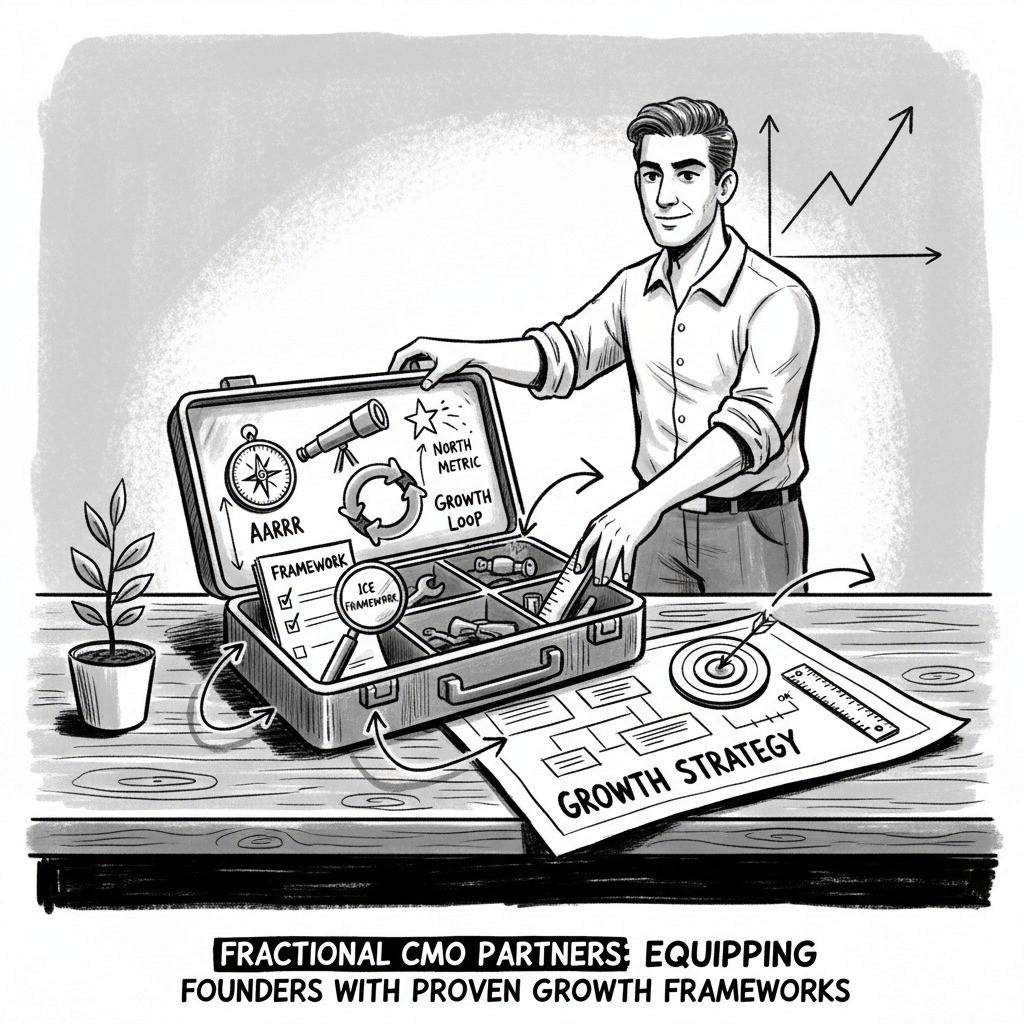
Growth Marketing Frameworks Every Founder Should Know

Written by: Sanjeev Arora
In today’s fast-changing digital world, every founder faces the same challenge: how to grow efficiently without overspending. Growth marketing isn’t just about running campaigns or pushing sales—it’s about creating systems that generate consistent, measurable results. Whether you’re launching a startup or scaling a mid-sized business, the right growth marketing frameworks can help you build momentum and resilience.
According to Deloitte’s 2023 Global Marketing Trends Report, organizations that apply structured, data-led growth strategies are twice as likely to exceed their business goals. Yet, most founders still rely on intuition over frameworks. That’s where strategic marketing leadership—like what a Fractional CMO provides—becomes a game-changer.
What is a Growth Marketing Framework?
A growth marketing framework is a repeatable process that guides how your company attracts, converts, and retains customers. Unlike traditional marketing that focuses on short-term campaigns, growth frameworks emphasize long-term scalability and optimization.
They combine data, creativity, and experimentation to identify what drives sustainable business results.
For founders, frameworks act as roadmaps—ensuring every marketing effort contributes to a bigger goal: growth that lasts.
1. The AARRR Framework (Pirate Metrics)
Created by Dave McClure, the AARRR model (Acquisition, Activation, Retention, Revenue, Referral) is one of the most popular growth frameworks among startups.
Acquisition: How customers find you
Activation: First positive user experience
Retention: Keeping users engaged
Revenue: Monetizing the user base
Referral: Turning users into advocates
This model encourages founders to measure every stage of the customer journey. For instance, improving retention by even 5% can boost profits by up to 95% (Bain & Company). That’s why top growth teams use AARRR as a guiding compass.
2. The North Star Metric Framework
Every growing company needs a North Star Metric (NSM)—a single measurement that captures the core value you deliver to customers. For Airbnb, it’s “nights booked.” For Slack, it’s “messages sent.”
Your NSM helps align all teams around growth that truly matters. It’s not just about traffic or clicks—it’s about impact.
If your marketing and sales aren’t aligned around this shared goal, you risk inefficiency. Learn how alignment works in this guide on How a Fractional CMO Can Align Sales and Marketing Teams.
3. The Growth Loop Framework
Unlike funnels, growth loops focus on self-sustaining systems where outputs create inputs for future growth. For example, a customer shares your product on social media (output), bringing in new users (input). This model emphasizes retention, product experience, and advocacy.
Many modern SaaS companies thrive because they build growth loops into their user journey—turning customers into marketing assets.
4. The ICE Framework (Impact, Confidence, Ease)
For early-stage startups, not every growth idea can be tested at once. The ICE scoring framework helps prioritize ideas by rating each on:
Impact – potential to drive growth
Confidence – belief in the success rate
Ease – resources and effort needed
This method helps founders decide what to execute next—especially useful during resource constraints or market downturns. You can explore more about navigating such periods in How a Fractional CMO Guides Companies Through Market Downturns.
5. The Bullseye Framework
Developed by Gabriel Weinberg and Justin Mares in Traction, the Bullseye Framework helps identify which marketing channels truly work.
You brainstorm possible channels, test them in small batches, and double down on the most effective one. This framework prevents you from wasting time on channels that don’t drive measurable growth.
6. The OKR Framework (Objectives and Key Results)
Popularized by Google, OKRs ensure that every marketing initiative aligns with company objectives. They combine ambition with accountability, allowing teams to move fast while staying on track.
For founders, OKRs simplify decision-making and foster collaboration—especially when supported by a Fractional CMO, who bridges leadership gaps without the full-time cost. Learn the difference between models in Fractional CMO vs. Marketing Agency.
Why Growth Marketing Frameworks Matter for Founders
Without a structured framework, founders risk reactive marketing—making decisions based on trends, not data. Frameworks:
Clarify priorities and eliminate guesswork
Enhance alignment across departments
Provide measurable outcomes
Help teams stay resilient through market shifts
Most importantly, they help you build a predictable system for growth—not just one-time wins.
When to Bring in a Fractional CMO
If your growth feels stuck, or your marketing lacks strategic direction, it may be time to bring in a Fractional CMO. They provide:
Senior-level strategy without the cost of a full-time executive
Cross-functional leadership across sales, marketing, and operations
Proven frameworks for sustainable growth
Partnering with a seasoned marketing leader can turn chaos into clarity and performance into progress.
Partner with Fractional CMO Partners
At Fractional CMO Partners, we help founders unlock growth using proven marketing frameworks and data-driven strategies. Whether you’re scaling up or stabilizing through uncertainty, our team of seasoned marketing leaders becomes your strategic growth partner—guiding you with clarity, precision, and measurable impact.
Accelerate your company’s growth today—partner with experts who understand how to turn frameworks into results
FAQs
Q1. What is a growth marketing framework?
A structured process that guides customer acquisition, retention, and revenue growth using data-driven experimentation.
Q2. Why are growth frameworks important for startups?
They create focus, ensuring every marketing effort contributes to measurable results.
Q3. What’s the difference between growth marketing and traditional marketing?
Growth marketing focuses on long-term, data-driven scalability; traditional marketing often focuses on short-term campaigns.
Q4. Which is the most effective growth framework?
The AARRR framework remains a favorite for startups due to its full-funnel focus.
Q5. Can small businesses use growth frameworks?
Absolutely. Frameworks scale with your business size and help optimize limited resources.
Q6. How do I choose the right framework for my company?
Start with your goals and resources. For data-driven growth, AARRR or OKRs are good starting points.
Q7. What role does a Fractional CMO play in growth marketing?
They implement proven frameworks, align teams, and create strategy clarity—driving faster and more efficient growth.
Q8. How can growth frameworks help in a market downturn?
They help you prioritize what works, optimize spend, and focus on customer retention—key to surviving and thriving in downturns.