The Guide to B2B SaaS Growth Marketing: Building a Revenue Engine

Written by: Sanjeev Arora
In the world of B2B SaaS, "growth" is often confused with "getting more leads." But for a technology company to scale, growth cannot just be about adding new emails to a database.
True B2B SaaS Growth Marketing is different. It is an engineering approach to marketing. It focuses on the entire lifecycle of a customer—not just getting them to sign up, but ensuring they stay, pay, and refer others.
This guide explains what growth marketing actually is, why it matters for SaaS companies, and the four pillars you need to build a sustainable revenue engine.
What is Growth Marketing?
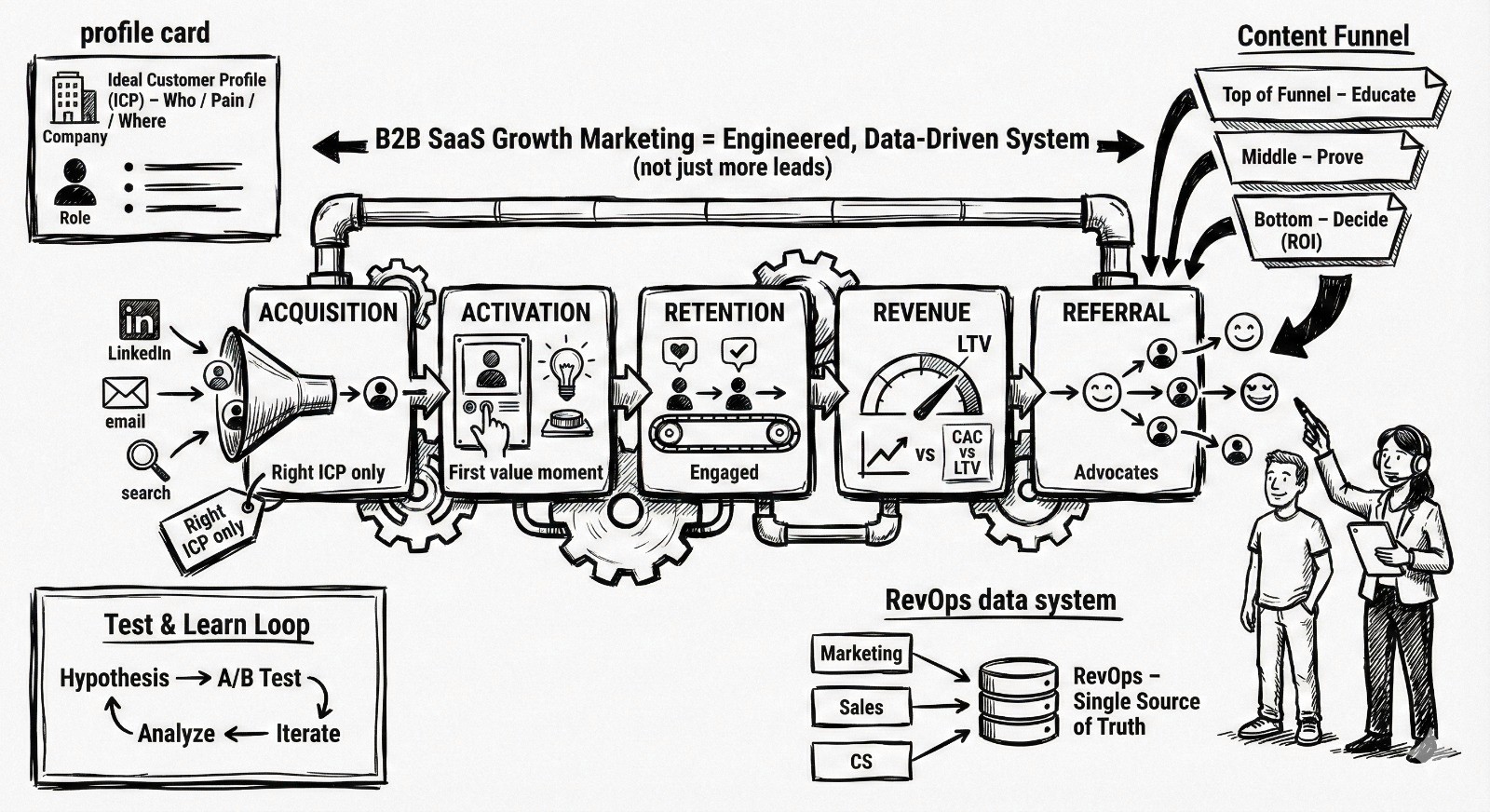
Growth Marketing is a data-driven strategy that optimizes the entire customer journey. Unlike traditional marketing, which often stops after a lead is generated, growth marketing uses data and experimentation to improve every stage of the funnel:
● Acquisition: Attracting the right users.
● Activation: Getting users to experience the product's value quickly.
● Retention: Keeping customers engaged to reduce churn.
● Revenue: Maximizing Lifetime Value (LTV).
● Referral: Turning happy customers into advocates.
In simple terms: Traditional marketing screams "Buy this!" Growth marketing asks, "How can we make the buying and using experience so good that growth happens automatically?"
Why B2B SaaS Needs a Different Approach
Software-as-a-Service (SaaS) is unique because revenue comes over time, not all at once. If you pay a lot to get a customer (high Customer Acquisition Cost or CAC) but they leave after two months, you lose money.
A growth marketing strategy focuses on the ratio between CAC and LTV. It aligns marketing with product and sales teams to ensure that the promise made in the ad is delivered in the product.
The 4 Pillars of a B2B Growth Engine
1. The "Ideal Customer Profile" (ICP)
You cannot grow if you are selling to everyone. Efficient growth starts by defining your Ideal Customer Profile (ICP).
● Who are they? (Industry, company size, role)
● What is their pain? (What problem is costing them money?)
● Where do they live? (LinkedIn, industry forums, email newsletters)
Expert Insight: If your messaging tries to speak to everyone, it will resonate with no one. Nailing your ICP lowers your ad costs and speeds up sales cycles.
2. Full-Funnel Content Strategy
In B2B, buyers do their own research. Your content needs to answer their questions before they even talk to a salesperson.
● Top of Funnel: Educational blog posts and social content that solve problems (Demand Generation).
● Middle of Funnel: Case studies and webinars that prove your solution works.
● Bottom of Funnel: Comparison guides and ROI calculators that help them make a purchase decision.
3. Rapid Experimentation (The "Test and Learn" Loop)
Growth marketing is scientific. You don't guess; you test.
● Hypothesis: "If we change the headline on the pricing page to focus on 'saving time,' sign-ups will increase."
● Test: Run an A/B test for two weeks.
● Analyze: Did it work? If yes, keep it. If no, learn why and try again.
This constant loop of testing creates small improvements that add up to massive growth over time.
4. Revenue Operations (RevOps)
Data is the fuel for your growth engine. You need a clean system (like HubSpot or Salesforce) where marketing, sales, and customer success data live together. This allows you to see which marketing campaigns actually resulted in revenue, not just clicks.
Need Help Building Your Engine?
Building a data-driven growth system requires experience in strategy, technology, and content. For many companies, hiring a full-time executive to build this from scratch is too costly or risky.
Fractional CMO Partners provides B2B SaaS companies with experienced marketing leadership on a flexible basis. We step in as your strategic partner to define your ICP, build your growth engine, and execute a Go-to-Market strategy that delivers measurable revenue—without the overhead of a full-time executive.
FAQs
1. What exactly do growth marketing services include?
They combine strategic planning, demand generation, analytics, content marketing, automation, and go-to-market execution—all customized to your business objectives.
2. How do growth marketing services differ from digital marketing?
While digital marketing focuses on channels and tactics, growth marketing emphasizes long-term scalability through data, experimentation, and full-funnel optimization.
3. Can I hire Fractional CMO Partners for short-term projects?
Absolutely. Our model supports part-time, project-based, or ongoing engagements tailored to your business needs.
4. Do your fractional CMOs work directly with internal teams?
Yes. Collaboration is central to our approach—we integrate seamlessly with your team to build systems that last beyond our partnership.
5. How long before I start seeing measurable results?
Many clients experience improved pipeline quality and ROI within 90 days, though full-scale transformation typically unfolds over six to twelve months.
6. Are growth marketing services suitable for early-stage startups?
Yes. We specialize in helping startups establish their marketing foundations and achieve early traction efficiently.
7. What industries do you serve?
We focus primarily on B2B tech sectors including SaaS, cloud computing, fintech, AI, and enterprise software.
8. Where can I learn more about hiring a fractional CMO?
Visit our comprehensive Fractional CMO FAQs page to explore everything you need to know before engaging a partner.