HOW TO DEFINE YOUR BRAND: A STRATEGIC BLUEPRINT

Written by: Vipul Oberoi
Brand, Branding, Brand Identity, Brand Strategy, Brand Philosophy. Different names, same game. It is ultimately how your brand presents itself and wants to be perceived by its target audience.
I call it Brand Definition.
It is not about the logo. It not about that punchy tagline. It is a strategic framework designed to create a pull within your target audience. It’s a blueprint of your brand.
Here’s a step-by-step process to define yours.
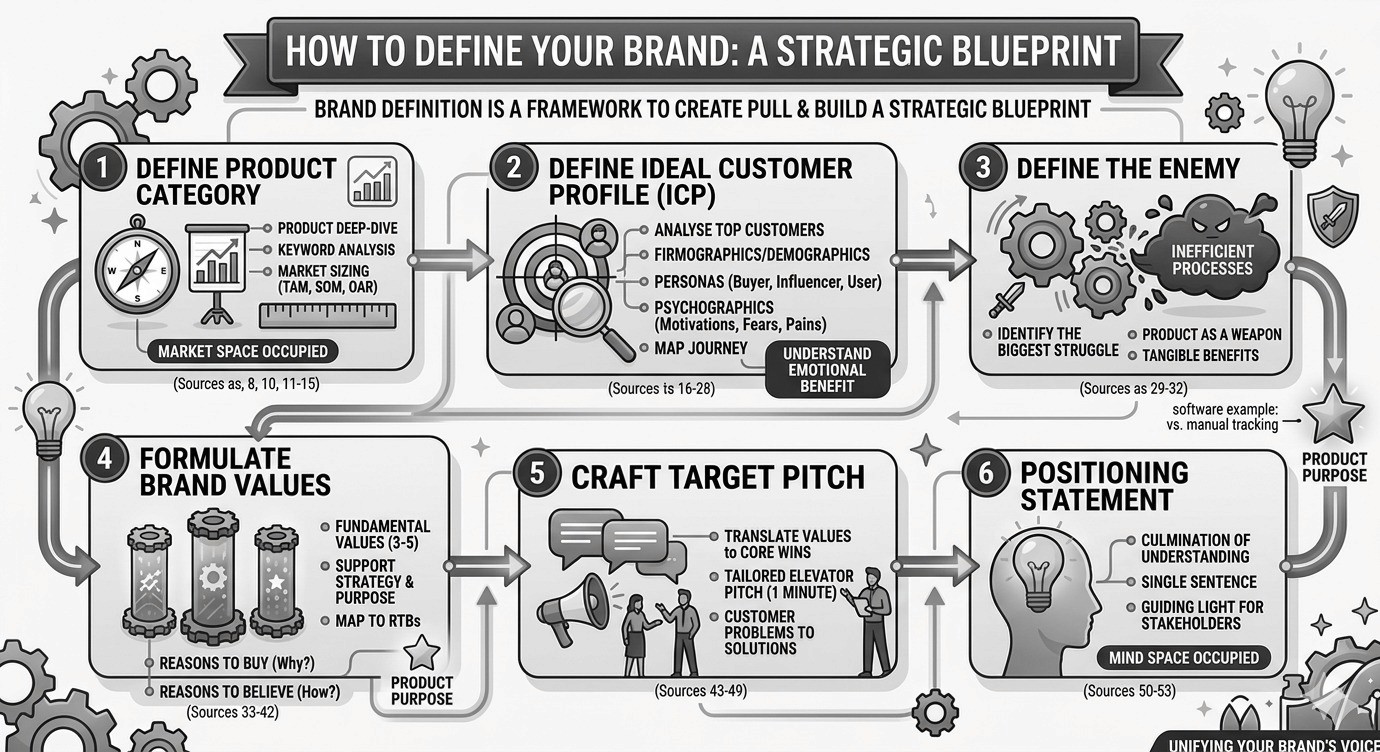
1. Define Product Category first
Do not confuse this with positioning. Positioning is the space occupied in the mind of the consumer; product category is the space occupied in the market. Before you seek a position in the mind, you must identify your position in the market.
There are three steps that you should undertake to define product category:
Deep-dive into every technical and brand-related aspect of your product.
Conduct a comprehensive keyword analysis to identify industry-standard terminology.
Conduct a market sizing exercise to estimate your SAM (Serviceable Addressable Market), SOM (Serviceable Obtainable Market), and OAR (Obtainable Annual Revenue).
2. Build your Ideal Customer Profile (ICP)
If you are talking to everyone, then you are being heard by none. In the race to scale, many businesses fall into the “Product-First” trap: build a great tool, then go hunting for a crowd. Successful brands do the opposite: they find the person, understand their pain, and build a bridge to the solution. That bridge is built by defining the Ideal Customer Profile (ICP).
There are five steps to build an ICP.
Analyse your top customers. Look at who already finds the most value in your product.
Define firmographics / demographics of your top customers. Identify the specific traits of those companies and individuals.
Identify the buyer/customer, influencer, and end-users/consumer personas.
Go deeper into the psychographics, and understand their motivations, fears, and pain points.
Map their buying journey to understand the path they take from realizing a problem to purchasing a solution.
The motivations, fears, and pain points will help you understand the emotional benefit: why your product matters to the ICP.
3. Identify the Enemy
Once you understand your ICP’s pain points, you can identify the "Enemy"—the specific obstacle your product is designed to defeat. Instead of just listing features, position your product as a weapon.
When you would have analysed the product and the ICP, you would get to know the tangible benefits that the target audience derives from the product.
Instead of just listing features, your strategy should be to identify the "Enemy": the one thing that the product can be used as a weapon against. For example, an office automation software is a weapon against inefficient, manual tracking using registers and spreadsheets.
4. Formulate the Brand Values and RTBs
Brand Values are the fundamental values of the business that support the overall brand strategy. Product deep-dive, category definition, keyword analysis, and identification of enemy help us in defining the Brand Values. A business should have three to five brand values, not more.
Brand Values should ultimately support the Product Purpose, which is that one thing that your product is meant to achieve.
To make these values actionable at a product level, map them against your RTBs:
Reasons To Buy (“The Why”): Map your Brand Values to the motivations, problems, and fears because of which the target audience will buy your product
Reasons to Believe (“The How”): The killer features or strategic outcomes that assure the potential customer that your brand will deliver on the promises.
5. Craft the Target Pitch
Till now, we had laid the foundations of the brand. This is where the foundation meets the market, where it needs to translate thoughts into conversations. Here again, your Brand Values are the key.
For each target segment, write down what each brand value (and consequently the RTBs) helps the customer in achieving. These are the Core Wins for each target segment.
You need to talk to customers what they would like to hear, that is, how your product will solve their problems. The core wins become your Elevator Pitch – a tailored, one-minute monologue that addresses problems of each target segment.
6. Positioning Statement
As mentioned before, it is the space that you occupy in the mind of the target segment. A positioning statement is not the starting point, it is the culmination of the deep understanding of your product, your brand, and the target customer segments, distilled into one sentence that becomes the guiding light for all stakeholders in your business.
Conclusion
Ultimately, brand definition is about moving beyond superficial aesthetics to build a structural foundation that generates genuine market pull. It is a rigorous exercise in strategic understanding, commencing from the physical space your product occupies in the market to the precise emotional space it holds in the mind of your ideal customer.