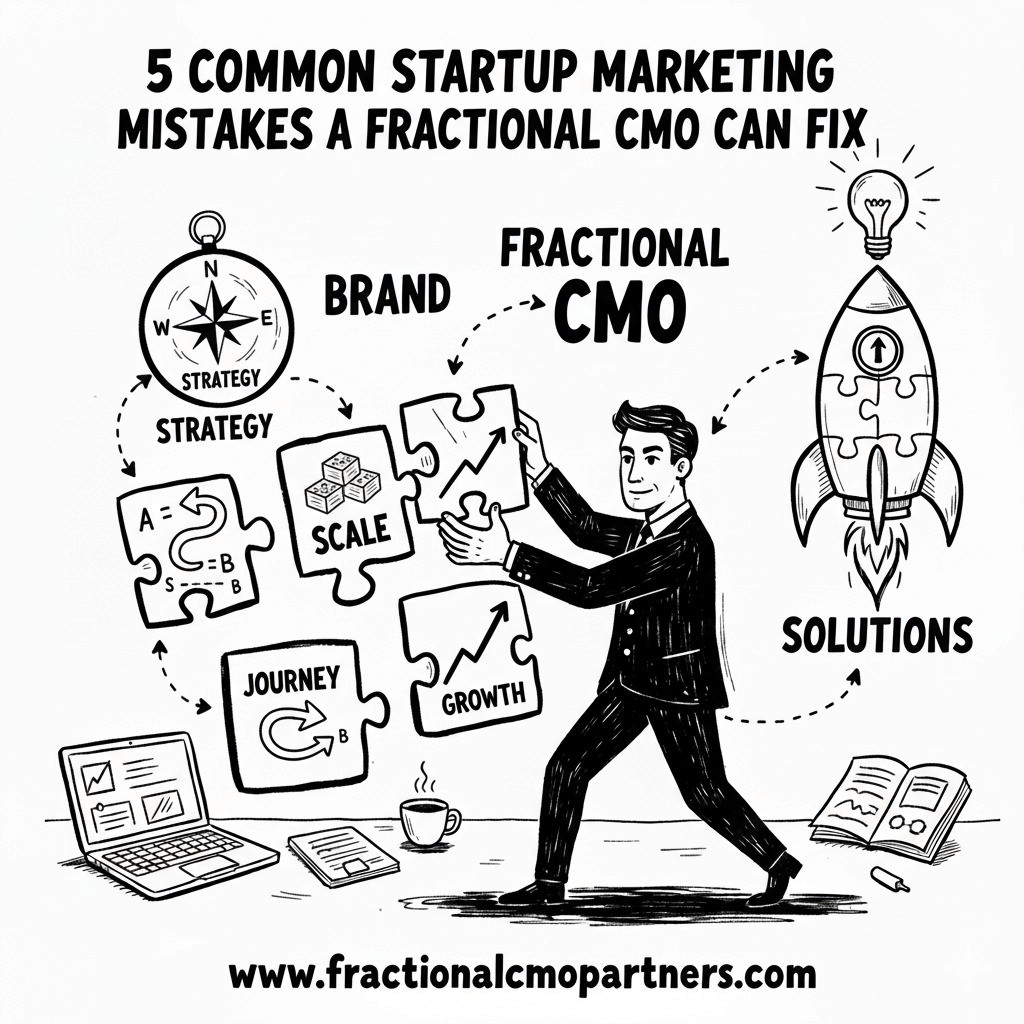
5 Common Startup Marketing Mistakes a Fractional CMO Can Fix

Written by: Jayant Kshirsagar
Launching a startup feels like jumping off a cliff and building your parachute on the way down. Founders juggle funding, product development, and hiring—while marketing often gets treated like an afterthought. The result? Great products fail to find traction.
That’s where a Fractional CMO makes the difference. A Fractional Chief Marketing Officer provides executive-level marketing leadership on a part-time basis—helping startups build scalable, strategic marketing foundations without the cost of a full-time CMO.
According to HubSpot’s 2024 Startup Growth Report, 65% of startups cite ineffective marketing as their biggest growth obstacle. The good news? Most of these mistakes are fixable—with the right guidance.
Here are five common startup marketing mistakes and how a Fractional CMO can turn them into opportunities for growth.
1. Focusing on Tactics Before Strategy
Many startups start “doing marketing” before they understand why they’re doing it. They rush into social media, ads, or SEO without a clear strategy. The result? Scattered efforts and wasted budget.
A Fractional CMO helps you build from the ground up—starting with audience research, positioning, messaging and measurable goals. Instead of random acts of marketing, every campaign serves a purpose.
Example: A SaaS startup spent thousands testing Facebook ads but saw minimal ROI. When a Fractional CMO redefined their customer personas and messaging, click-through rates improved by 120% in just two months.
To explore how expert CMOs tailor strategies specifically for software companies, check out Fractional CMO Services for SaaS Startups.
2. Ignoring Brand Positioning and Consistency
Inconsistent branding confuses customers. Many startups use different logos, taglines, and tones across platforms—making it hard for audiences to recognize them.
A Fractional CMO ensures your brand story is unified and consistent across every touchpoint. They define your voice, craft your narrative, and ensure that each marketing channel reinforces your positioning.
According to Lucidpress’s 2023 Brand Consistency Report, brands that maintain consistent messaging see up to a 33% increase in revenue (Lucidpress Report).
Example: A fintech startup had three different taglines floating online. Once their Fractional CMO streamlined the messaging, lead conversions improved by 58%.
For more insights on evaluating top marketing leadership firms, explore the list of the Best Fractional CMO Companies.
3. Underestimating Data and Analytics
Many startup founders rely on intuition instead of analytics. But in today’s competitive landscape, data is your roadmap. Without tracking what works, you can’t repeat it—or scale it.
A Fractional CMO implements metrics that matter: customer acquisition cost (CAC), lifetime value (LTV), and funnel conversion rates. They help founders make informed decisions, not guesses.
According to Gartner, companies using data-driven marketing are six times more likely to be profitable year over year.
Example: A D2C brand realized, through CMO-led analytics, that 70% of purchases came from returning customers. That insight shifted their focus to retention marketing, resulting in a 45% lift in repeat sales.
4. Neglecting the Customer Journey
Startups often chase leads but ignore what happens after capturing them. Poor follow-ups, lack of nurturing, or irrelevant content cause warm leads to turn cold quickly.
A Fractional CMO maps out the entire customer journey, identifying where prospects drop off and creating systems to re-engage them. From first touch to post-sale loyalty, they ensure every stage is optimized.
Example: A B2B tech startup thought it needed more leads. After review, the Fractional CMO discovered that 80% of their leads were getting lost during onboarding. With a simple email automation sequence, customer activation rose by 35%.
If you’re unsure how this approach compares to traditional marketing agencies, see Fractional CMO vs. Marketing Agency.
5. Scaling Without the Right Infrastructure
Every founder dreams of scaling fast—but scaling without structure leads to burnout and inefficiency. Startups often expand their ad spend or hire multiple vendors without aligning systems or strategy.
A Fractional CMO sets up the foundation for growth—choosing the right tech stack, aligning your marketing and sales teams, and creating repeatable playbooks. This makes scaling smoother and more cost-efficient.
Example: A health-tech startup wanted to triple its ad budget. Their Fractional CMO advised them to fix conversion tracking first. After restructuring their funnel, they achieved 3x growth without increasing spend.
This kind of scalable marketing leadership is what separates early-stage chaos from sustainable growth—and why Fractional CMOs are becoming essential for modern startups.
Why a Fractional CMO Is a Startup’s Secret Advantage
Startups often can’t afford a full-time CMO, but they can’t afford not to have marketing leadership either. That’s why Fractional CMOs are the bridge—bringing enterprise-level expertise at a startup-friendly cost.
They create order from chaos, clarify brand purpose, and build systems that don’t collapse under growth. Whether you’re refining positioning or preparing for your next funding round, a Fractional CMO turns strategy into momentum.
For founders who want a clear understanding before hiring one, explore these detailed Fractional CMO FAQs.
Ready to Fix Your Startup’s Marketing Mistakes?
Your startup deserves marketing that drives real growth—not guesswork. Partner with experts who’ve scaled successful brands.
Fractional CMO Partners brings the clarity, strategy, and leadership your business needs—without the full-time cost.
Visit Fractional CMO Partners today to connect with experienced marketing leaders who can accelerate your growth, align your vision, and build lasting brand success.
FAQs
Q1. What is a Fractional CMO?
A Fractional CMO is a part-time marketing executive who provides strategic direction, leadership, and oversight without the cost of a full-time hire.
Q2. When should a startup hire one?
When you’ve found product-market fit but need structured marketing to scale effectively.
Q3. How does a Fractional CMO differ from a marketing agency?
Unlike agencies, they integrate directly with your leadership team and manage both strategy and execution.
Q4. How long should a startup keep a Fractional CMO?
Typically 6–12 months, depending on your growth phase and marketing maturity.
Q5. Can a Fractional CMO work remotely?
Yes. Many operate virtually, offering flexibility without sacrificing strategy.
Q6. What industries benefit most from Fractional CMOs?
SaaS, tech, B2B, eCommerce, and early-stage startups benefit the most from strategic marketing leadership.
Q7. How do I measure a Fractional CMO’s impact?
By tracking improved ROI, conversion rates, and alignment between marketing and revenue goals.
Q8. What’s the first step to hiring one?
Start with a discovery call to align on your goals, pain points, and growth roadmap.