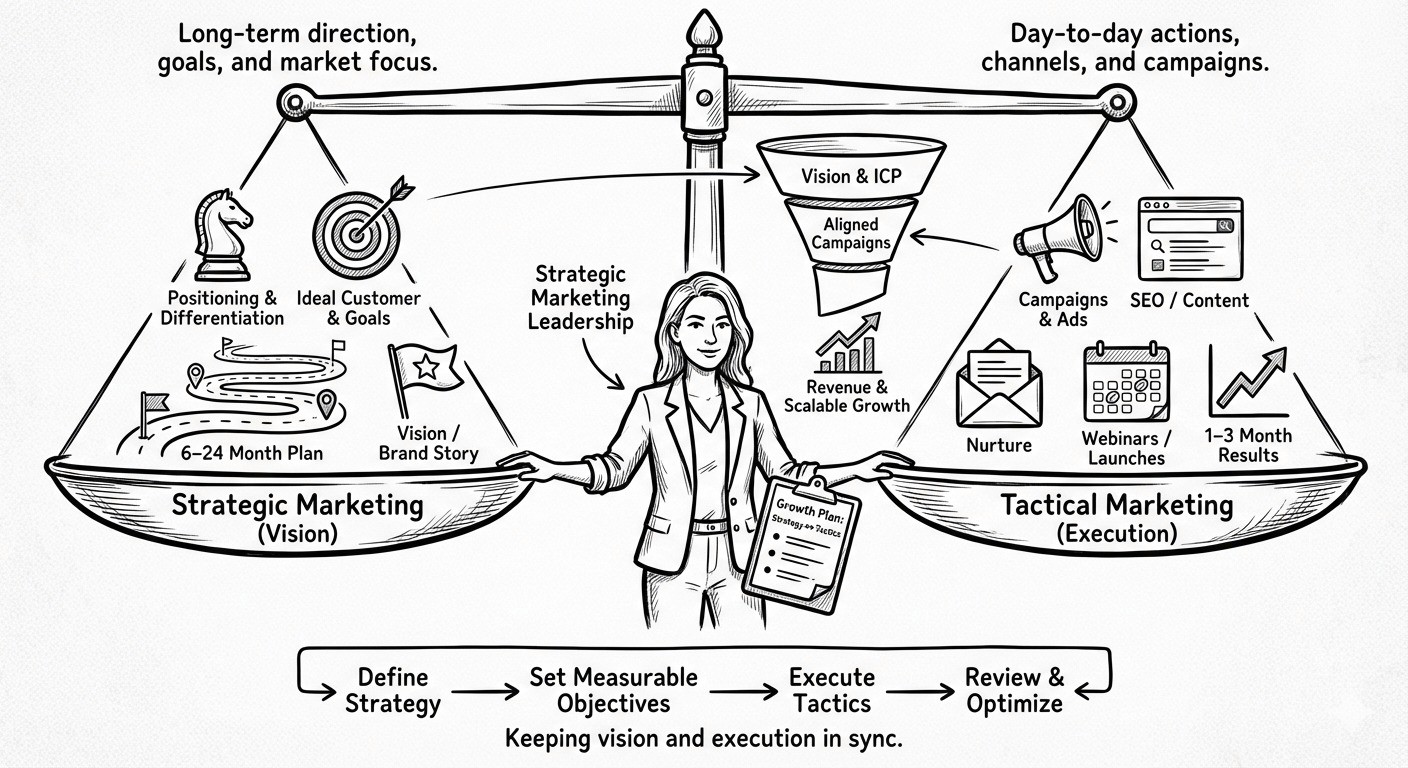
Strategic Marketing vs Tactical Marketing: How to Balance Vision and Execution for Scalable Growth

Written by: Sanjeev Arora
Introduction: Why the “Strategy vs Tactics” Debate Still Matters
Imagine a fast-growing startup with a brilliant product, a motivated team, and enough funding to launch multiple campaigns. Yet, after six months, growth has stalled. The problem isn’t the lack of effort—it’s the lack of alignment between strategy and tactics.
This is one of the most common challenges businesses face today. Some teams over-invest in execution—running ads, launching webinars, and sending newsletters—without a clear long-term direction. Others spend months crafting visionary strategies but fail to act quickly enough to see results.
Understanding the difference between strategic marketing vs tactical marketing is crucial for any business aiming to scale efficiently and sustainably. According to CoSchedule’s 2024 Marketing Strategy Report, marketers who set clear goals are 376% more likely to report success (CoSchedule).
This article explores the key differences between strategic and tactical marketing, how they complement each other, and why aligning both is the cornerstone of scalable growth.
What Is Strategic Marketing? The Long Game
Strategic marketing defines the “why” behind your marketing efforts. It’s the process of aligning business goals with audience insights, competitive positioning, and brand storytelling.
A strong strategic marketing plan establishes your company’s long-term direction—who your ideal customers are, how you solve their problems uniquely, and what your brand stands for. It’s not about immediate wins; it’s about building a foundation that supports sustainable growth.
For startups and mid-sized businesses, this often means creating a structure that connects leadership vision to execution. Partnering with a fractional CMO agency can help you achieve this alignment without the overhead of hiring a full-time executive team. These agencies provide experienced marketing leadership that integrates data-driven planning with brand growth strategies tailored to your business stage.
What Is Tactical Marketing? The Power of Action
If strategy defines the direction, tactics define the path. Tactical marketing focuses on short-term, actionable steps that execute the broader strategy.
This includes campaign management, lead generation, paid advertising, social media marketing, and SEO. It’s where ideas turn into measurable actions. Tactical marketing answers the “how” questions:
How will we attract leads?
How will we nurture them?
How will we convert them into loyal customers?
Example: Tactical Execution in Action
A cybersecurity startup may run a time-bound LinkedIn ad campaign targeting IT leaders to drive demos for a new software feature. While these activities deliver measurable results, they are only effective when aligned with the company’s larger marketing objectives.
To bridge this gap, many business owners choose to hire fractional CMO professionals who can balance strategic vision with tactical execution—ensuring every marketing dollar contributes to long-term business outcomes.
Strategic vs Tactical Marketing: Key Differences and the Need for Alignment
While both are vital, they operate on different timelines and levels. The most successful companies integrate them seamlessly to achieve balance.
Aspect | Strategic Marketing | Tactical Marketing |
Focus | Long-term goals and positioning | Short-term execution and campaigns |
Timeline | 6–24 months | 1–3 months |
Metrics | Brand equity, market share, customer lifetime value | Click-through rate, conversions, ROAS |
Responsibility | Leadership and CMO team | Marketing specialists and managers |
Objective | Set vision and direction | Deliver measurable results |
Businesses that successfully combine both approaches enjoy stronger, more predictable growth. In fact, CoSchedule’s research found that teams with a documented strategy are 313% more likely to achieve success than those without one (CoSchedule Study).
Case Study: Turning Vision into Measurable Growth
A B2B SaaS company once approached Fractional CMO Partners with a challenge—great technology but inconsistent revenue. The company had solid campaigns but lacked a cohesive direction.
By rethinking their strategic marketing plan, redefining audience segments, and introducing structured performance measurement, the results were transformational:
100 Sales Accepted Opportunities per month
58% increase in web form fills
3x growth in enterprise leads within a year
The Result of Strategic-Tactical Alignment
This outcome was made possible by integrating strategy and tactics—long-term planning powered by short-term execution. When both work in harmony, marketing becomes not just effective, but scalable.
Why the Right Leadership Makes All the Difference
In most scaling organizations, the gap isn’t effort—it’s leadership. Teams are busy executing, but often without a clear strategic compass.
That’s where fractional CMOs bring immense value. They blend years of leadership experience with agile execution to guide marketing teams efficiently and cost-effectively.
For global businesses, engaging a fractional CMO India team provides the added advantage of local expertise, time zone flexibility, and cost efficiency—without compromising on strategic excellence.
Fractional CMOs ensure marketing plans remain consistent with business objectives, enabling organizations to scale sustainably while optimizing spend and outcomes.
How to Build a Balanced Marketing Framework
A balanced marketing framework keeps strategy and tactics in sync. Here’s a simple, actionable model that business leaders can adopt to create harmony between vision and execution:
1. Define Your Strategy
Start with clarity. Establish business goals, audience personas, and brand positioning that connect marketing objectives directly to growth outcomes.
2. Set Measurable Objectives
Use OKRs or KPIs that align with revenue and retention goals. Your strategy should always tie back to measurable impact.
3. Execute with Precision
Develop and deploy targeted campaigns, content strategies, and automation tools to bring the strategy to life.
4. Review and Optimize
Leverage analytics, attribution models, and data feedback loops to refine your approach continuously.
Maintaining this loop ensures your strategy remains agile while your tactics stay effective. To find inspiration or expertise, explore some of the Best Fractional CMO Companies that have built reputations for helping brands align leadership vision with tactical excellence.
Vision Without Action Is Just an Idea
The distinction between strategy and tactics isn’t about choosing one over the other—it’s about making them work together. Strategy without execution is just theory; execution without strategy is chaos.
According to HubSpot’s 2024 Marketing Trends Report, 82% of high-performing companies align strategic objectives with tactical execution regularly. This alignment fuels consistent growth, adaptability, and lasting customer engagement.
When both are balanced, businesses achieve momentum—growing faster, smarter, and more sustainably.
Transform Strategy into Scalable Growth
At Fractional CMO Partners, we don’t just craft marketing plans—we build growth engines. Whether your goal is to refine your brand strategy or accelerate demand generation, our experienced fractional CMOs deliver measurable results with precision and speed.
Ready to transform your marketing from reactive to strategic?
Book a consultation today and start scaling your business with clarity, confidence, and impact.
FAQs on Strategic Marketing vs Tactical Marketing
1. What is the main difference between strategic and tactical marketing?
Strategic marketing focuses on long-term goals—defining where the business wants to go and why. Tactical marketing focuses on short-term actions—how to get there through campaigns, content, and execution. Both must work together to drive measurable growth.
2. Why is it important to balance strategy and tactics in marketing?
Balancing both ensures that every marketing action supports a clear goal. Without strategy, tactics lack direction; without tactics, strategy lacks results. Businesses that align the two see more consistent and scalable growth outcomes.
3. Can small businesses benefit from strategic marketing?
Absolutely. Even startups and small businesses need a strategic foundation. A clear marketing strategy helps them prioritize limited resources, identify their ideal customers, and compete effectively against larger players.
4. How does a fractional CMO help with strategic and tactical marketing?
A fractional CMO bridges the gap between vision and execution. They define long-term marketing strategies, oversee tactical implementation, and ensure both are aligned with business objectives—without the high cost of a full-time CMO.
5. What are some examples of tactical marketing activities?
Tactical activities include launching digital ad campaigns, email marketing, SEO optimization, creating sales enablement materials, and social media promotions. These are short-term actions designed to fulfill the overall strategy.
6. How can I tell if my company needs strategic or tactical marketing support?
If you lack a clear growth roadmap, you likely need strategic help. If you have a strategy but struggle with execution or performance, tactical support is key. Many organizations benefit from combining both—something a fractional CMO can provide seamlessly.